KDI 20: Productive Public Space
A Conversation with Christian Rodriguez Ceja and Franklin Kirimi
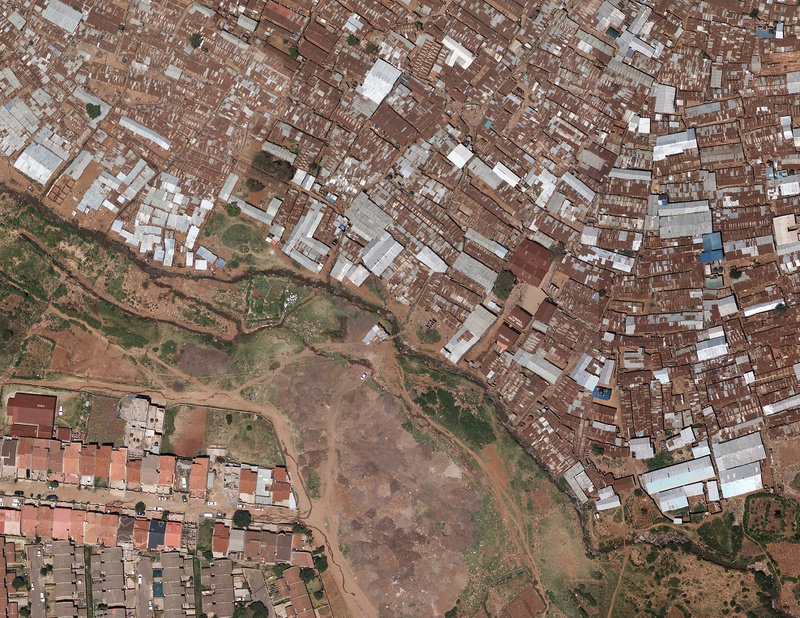
California’s Eastern Coachella Valley is about 9,600 miles (15,450 km) from Kibera, an informal settlement in Nairobi, Kenya. The former is a sprawling desert landscape of mobile home communities, irrigated orchards, and dispersed settlements around the Salton Sea, home to roughly 26,500 people. The latter packs roughly a quarter-million residents into a dense urban patchwork of corrugated metal roofs, open-air markets, and narrow paths tracing streams and drainage channels.
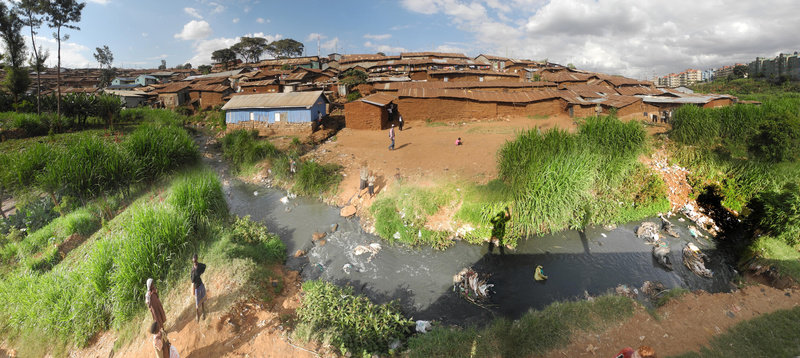
For all their vast geographic and cultural differences, the two communities have co-evolved as the two primary locations where KDI has set its deepest roots over the past two decades. If you look past the obvious contrasts, symmetries emerge. Foremost, both have long histories of fractured investment in infrastructure and strong traditions of resident organizing. And when you pull a specific thread in either place—an environmental issue, a bureaucratic knot, a spatial morass—you often find them connected in unexpected ways, or unearth lessons that travel surprisingly well from one locale to another, from Swahili to Spanish.
In Kibera, as detailed in the series introduction, these conditions gave rise to KDI’s first series of Productive Public Spaces (PPS). Initially, this was not so much a theory of action as a rational response to site conditions. Each project set out to convert flood-prone, polluted, or “unproductive” land into hubs for education, sanitation, gathering, and play, based on community needs. In the process, a replicable method came into focus: investing in spatial improvements also meant reinforcing the social networks needed to sustain them, from youth development groups to resident-run stand-ins for absent utilities.
Through these projects, the model driving much of KDI’s work was set into motion. Each project paired a spatial change—a stabilized riverbank, a public park, a toilet block—with a group of residents responsible for running and maintaining it, generating revenue through goods and services cycled back into the community. At the same time, each project became a sort of discovery process for the next, expanding based on feedback from residents to gradually form an ever-growing tributary system of sites and social initiatives. In Nairobi, lessons learned from the first series of projects in Kibera found parallels in the Eastern Coachella Valley, and vice versa. In this interview, leaders from both teams reflect and share contrasting experiences between the two continents.
I. A model that builds / "You gave us a wonderful park, but we can't get to it."
Christian, you grew up in the Coachella Valley, not far from what eventually became a series of Productive Public Spaces. What do you remember from your childhood there?
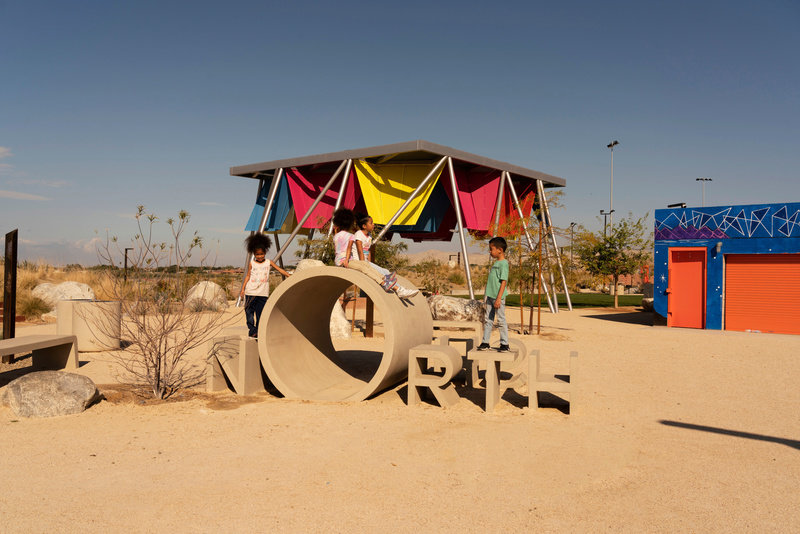
Christian Rodriguez Ceja: When I was a kid, we lived in a mobile home park not too far from where the Oasis Productive Public Space is today, at the old Oasis Elementary School. I was just outside the school boundary, but it could easily have been a school I went to. Around our home, there were sand dunes. We played by grabbing hardened balls of clay-heavy sand, throwing them at each other, and hiding. There were no parks.
That was me at eight years old. Then, at 30-something, I found myself working in the same familiar landscape. The day Oasis Park opened, they put up a movie screen and I saw all these kids in the front row watching a film. I said to Chelina, our CEO, “The most important thing about this project is that most of those kids won’t remember a time when there wasn’t a park. But I do.”
Can you trace how that work expanded over the past decade?
Christian: North Shore was just the beginning. Then we started talking about transportation because we heard from residents, “You gave us a wonderful park, but we can’t get to it.” That led to KDI working on a regional mobility plan. But the mobility plan opened up conversations about people not being able to access public transportation because there were no sidewalks or bus shelters, and it’s too damn hot to wait outside. The Eastern Coachella Valley reaches 120°F pretty regularly in the summer.
So we started thinking about bus stops. We worked with residents on a prototype shelter—but while we were working, we heard from residents, “We like your idea, but you’re not going to change an entire community’s transportation habits with one prototype. What about shade everywhere? I also need shade where I buy my groceries and send my kids to school.”
That opened up another scale of work, where we started thinking about shade across the entire Eastern Coachella Valley. At a high level, that’s how Productive Public Space works: you start with one site and expand based on the feedback you receive. At every step, residents will say, “Here’s an issue we can’t seem to get through. Can you help?”
Franklin, the progression Christian described in California grew from a framework first developed in Nairobi across the Kibera settlement. When you joined KDI a decade ago, what was the state of that work?
Franklin Kirimi: When I joined, the phrase “Productive Public Space” was already in use. I first joined as a volunteer working on the seventh Kibera Public Space Project. We had funding from the Swiss Re Foundation to assess flood risk across the entire watershed, working both at the site and regional scale. One of my first projects was in Andolo, a low-income area with direct exposure to both flooding and disease. There, we built prototypes for early-warning systems that persist to this day. Very early in my career, that work showed me how participatory design actually happens on the ground: the political dynamics, inside and outside the community, that shape what gets built, and how a single site connects to bigger questions.
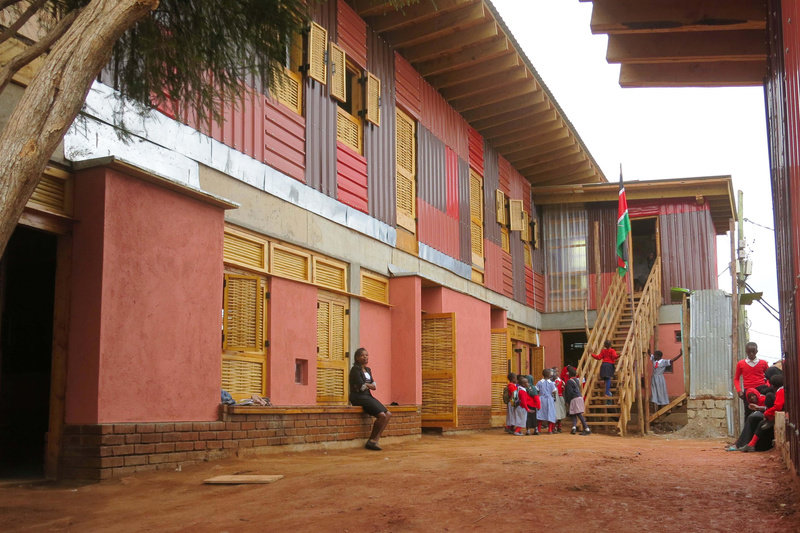
Around 2018, we began building Anwa Junior Academy. This was a new direction for KDI, thinking about Productive Public Spaces more holistically to encompass education and other social services. We tried to communicate across the settlement that KDI had funding to pursue this project, which allowed many other schools to join a community baraza to hear more, ask questions, and consider what a similar effort could look like in their own communities.
The Nubian community had started to gain recognition from the sitting government, so there was a lot of interest and speculation around land ownership. That threw a spanner into the planning process. We also had two very different clients, schoolchildren and adults, and had to co-design a space that met both of their needs.
With children, one thing that comes up is that play can be devalued by older members of a community. In informal settlements, it’s a constant question of trade-offs and who gets to decide what to do with very limited space. When children are given room to ask for what they want, you begin to see play spaces emerging in areas previously considered far too small to accommodate recreation. Younger people tend to think in a collective way that’s nested in an individual request: where can I hang out with my friends?
How did this model travel from Kibera to the Eastern Coachella Valley?
Christian: Someone Chelina knew was familiar with the work in Kenya and said, "Hey, do you know the Eastern Coachella Valley? There are a lot of similar dynamics there." I don't think the initial team expected to find an American parallel. But sure enough, there was a lack of infrastructure investment, which is still true in both places, and at the same time a real advocacy movement beginning to take off. Residents were organizing and asking where investment should go now that they had some attention. In Kenya, PPS was a way to address gaps in infrastructure while creating income-generating programs and keeping that value inside the community. All of that made sense here too.
II. A common definition / The kids come home
The word “productivity” can mean a lot of things depending where your pin is dropped. In a Western context, it’s often shorthand for economic productivity alone. Does that feel true in Coachella, and how is the phrase received differently in Nairobi?
Christian: It’s true that word has a certain economic connotation in the U.S. A lot of our problems stem from a highly stratified and unequal society that exploits labor and pays workers very little. The lack of access, opportunities, and funding we’re addressing through our projects in the Eastern Coachella Valley are outcomes of this system and are completely inseparable from it.
When I talk to people about Productive Public Spaces, it’s really about long-term investment and giving them the space to imagine what their community might look like in 10, 20 years, when many are primarily concerned with what their families need today. Part of this means asking people to engage in a more generational way, which has actually happened: kids tagging along to engagement sessions a decade ago are now young adults and college students, some of whom developed an interest in environmental justice. You may not feel the effects immediately, but it bears fruit as time passes.
Franklin: In Kibera, the sites we work with are often considered wasted or uninhabitable areas, often in riparian zones prone to inundation. Our ability to transform them into a space with value, to bring beauty and utility back to that site for residents, is what makes it productive above all else.
Is there a specific story that illustrates this for both of you?
Christian: In Oasis, there’s one couple in particular, Sylvester and Maria. They had three kids, with two older ones in elementary school, Edith and Eric. We made an effort to pull them in and get their feedback, though they didn’t always want to participate. They’re the reason a park was even considered in Oasis. They’d been working with another nonprofit to ask for open space funding, which they won. When KDI came on board, it became clear the willpower was there, just not the capacity—or trust that the system would actually deliver what was promised. Once North Shore was completed nearby, a lot of residents, including Sylvester and Maria, began to get more involved.
We were excited to see how the PPS model was progressing in Kenya and wanted to bring in some of their ideas. But in the U.S., you face a whole different set of liability questions; you can’t just hand over a park to residents to own and manage it. So we gathered the community and said, “Hey, there’s an opportunity for real partnership between you and the agency that will operate this park. We think you should help them decide what services and programs should be coming here.”
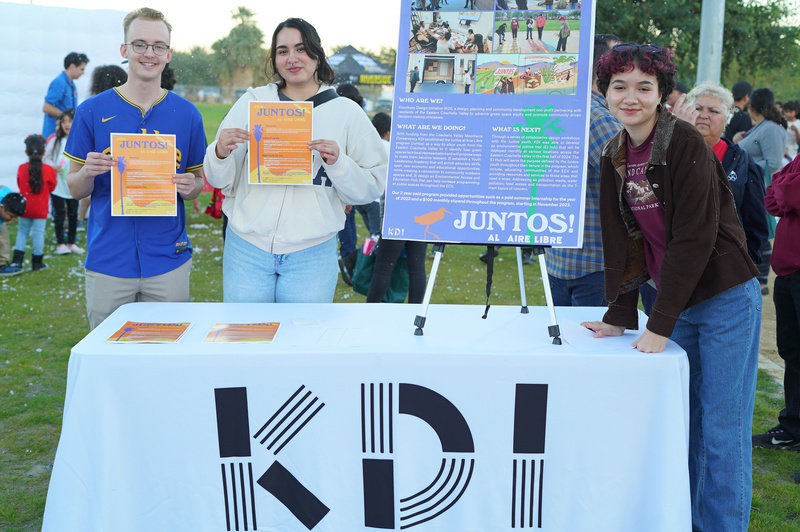
That conversation helped form the Oasis Leadership Committee (OLC), a resident group we’ve been working with now for over seven years. Sylvester and Maria’s daughter, Edith, became one of the first cohort members of Juntos al Aire Libre (Together Outdoors), a program for young adults that I started because I felt that if I had known about urban planning and landscape architecture when I was younger, it would have changed my life. Edith joined while in community college, then left for university, got her degree, and we hired her back as a fellow for six months. Now she’s working at the water district. In my dreams, these young people will be running agencies here in a few years. They’re brilliant.
There’s a picture I have framed in my office of a mobility planning workshop back in the early days. I’m pointing at something, and next to me is a little girl. That’s Edith. Now she’s my colleague, and her brother Eric is one of our four cohort leaders. That’s one family’s story, but it’s happened many times.
Franklin: Prisca Okila, our Senior Community Associate, is a wonderful example of this. We met when we were both quite young—I was just coming from school, but she was already highly involved as a leading community member for the fifth Kibera Public Space project in Gatwekera. At the time, I understood research from a more academic perspective, but Prisca understood that she could question the process and fine-tune it so it would actually benefit people. Now we have desks near each other and she’s managing a community-led weather forecasting initiative called Developing Risk Awareness towards Joint Action (DARAJA).
III. Beyond the site / "The real product is leaders."
In both Kibera and Coachella, individual projects have become microcosms for much broader environmental issues like heat, flooding, fire, and drought. How do you engage with big questions through piecemeal sites?
Christian: Around the Salton Sea, people are breathing in pretty toxic stuff, and it’s not getting better. When we first started working here in 2017, the state’s priorities really focused on cleaning up the air and water for pelicans, migratory birds, and fish. But we kept telling them: there are migratory people here too. They live along the same shorelines, and you’ve completely left them out of the conversation. I’d say that’s shifted at a state level.
Obviously, we’re currently working under an administration that has extensively cut funding related to climate adaptation and social equity. But we haven’t felt the cuts quite yet. In California, cap-and-trade money that polluters pay is going into resilience planning and infrastructure, and a climate bond passed in 2024. What has changed is agencies’ willingness to partner.
There used to be a sense that infrastructure projects should really limit public engagement and keep an engineering focus. When you bring residents in, they give feedback nobody wants to hear. You might ask about a park, but they’ll say: “Give us clean water, affordable housing, and accessible transportation.” And they’re right to. One thing I’ve learned is that parks, even though they can feel incredibly hard to build in the moment, can be low-hanging fruit. At the least they’re easier to talk about than extending water lines. When you complete a green space, residents build confidence in their ability to advocate for other essential services.
The real product is not the space itself, but leaders. People that came to our workshops because it was fun to do a stakeholder activity are now standing in front of decision-makers talking about much more complex environmental needs. At one point, many of the agencies kept their distance from a process like this. Now they see us as partners to identify projects and pursue funding opportunities alongside, and many begin by asking the community what should come next.
Franklin: In Kenya, there's legislation requiring public participation in government projects, so the conversation about what participation should look like is more attuned. We've been invited to present this work to governments in Kenya and, recently, eThekwini in South Africa, as cities think about how to plan for growth and upgrade informal settlements. Nairobi is home to UN-Habitat, and organizations like Slum Dwellers International and Akiba Mashinani Trust have embraced similar participatory processes. People can go see these spaces for themselves, and that's what gives them weight.
But under the current administration, there's little care for the processes we developed together with the government. We had signed memoranda of understanding with county governments, and there was real momentum toward rehabilitating rivers and building public infrastructure differently. That direction has stalled. Funding has shifted too. We don't receive direct support from the Kenyan government, and the wave of money for nature-based solutions has receded. There will be much more work ahead.
IV. Sharing authorship / Material justice
There’s a misleading idea in design practice today that equity-centric projects come at the expense of beauty—shoestring budgets, function over form, and so on. How would you counter that narrative?
Christian: Part of our value system is putting the ego aside. As a designer, you may want to be a great aesthetic voice, but we’re here to put our skills and expertise at work in service to the community’s vision. The reason places like North Shore are beautifully executed and detailed is because of the strength of that relationship, not in spite of it.
We don’t cut any corners. With projects like this, we have to do a lot of advocacy to insist on details residents asked for—boulders on the berms where teens can hang out, trees spaced to accommodate farmers’ markets. It was the first park in the region to foreground desert plants and drought tolerance; even Palm Springs was still dominated by lawns at the time.
Franklin, how would you say the tension between a designer’s vision and a community’s plays out in Nairobi?
Franklin: For us, it all begins with the education system. Even as an undergraduate, we’re taught landscape architecture from a very Western perspective, and some of us still wrestle with that as designers. KDI gives you room to think freely about how local knowledge and participation can inform the right outcome. We work with people from many backgrounds and design philosophies, and all of that shows up in the work. If you take the time to look, you can trace how every decision was made, who was involved, and where the influences came from.
Beauty sometimes comes from necessity. We’ve long used what some call “nature-based materials”—locally-sourced materials that residents already know how to use and care for. Bamboo can be planted along riverbanks to stabilize the soil and later become building material. Gabion cages (wire cages filled with stone) can also be used against erosion. Our first site in Kibera has a playground built from recycled timber.
You both came to this work by unlikely routes. How did you find your way here, and how has it affected how you see public spaces in your daily life?
Franklin: In Kenya, when you finish high school, you list your preferred programs and universities, but in the end the system assigns you. I trained at Jomo Kenyatta University of Agriculture and Technology. It's a discipline that isn't practiced much in commercial contexts, let alone in informal settlements. It was quite a niche space. One of my professors was Arthur Adeya, one of KDI's co-founders, and that's how I learned about the work. Coincidentally, this is my tenth year at KDI, so it's a good moment to look back on the whole journey.
There’s a disparity between the places I live and work. This work brings to the surface all the colonial injustice that has made things the way they are. We understand this and see it playing out; often it’s made worse by individuals or whole disciplines, knowingly or not. At the same time, that knowledge gives me a lot of clarity about what I need to be doing. It shows there’s room for things to be done differently. Our way isn’t the best way, but it’s one path forward. Trying to improve the process has been an important part of my career.
Christian: I came across KDI serendipitously, almost inevitably. I studied to be a Catholic priest for almost ten years. I did missionary work in Mexico, starting youth groups and organizing in different towns. Since I was a kid, I'd felt a calling to do something meaningful in the world, and I thought that was the path. Eventually I realized it wasn't, and came home not knowing what to do.
When an opening for an organizer at KDI opened, I initially didn't feel qualified. I had studied philosophy and theology, not planning or design. But I did a lot of research, and something clicked. In the seminary, you try to solve the world's problems through metaphysical change. What KDI offered was material justice: a physical manifestation of the work.